✨ “Hidden beneath the brain’s quiet throne lies a commander who whispers, and the whole body obeys.”
🌟 Introduction: The Hidden Maestro of the Mind
Imagine a realm where every organ is an instrument — the thyroid hums with warmth, the adrenals strike with lightning, the gonads craft the rhythm of creation. Yet above them all stands a single conductor, unseen but supreme: the pituitary gland.
Tucked deep within the skull, the pituitary is the link between thought and physiology, emotion and chemistry.
When you fall in love, it releases oxytocin; when you feel fear, it calls on ACTH; when you dream of growth, it sends forth GH.
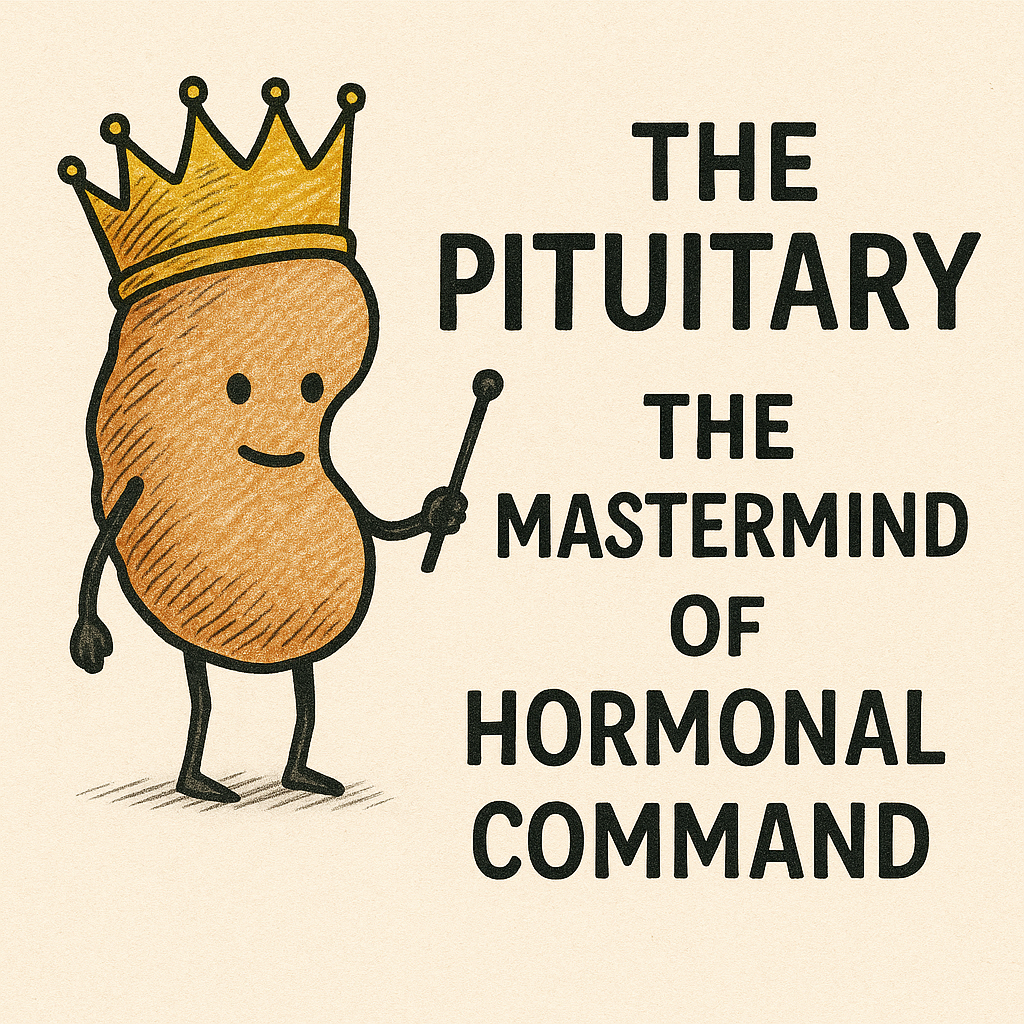
It is the “Mastermind of Hormonal Command”, governing all other glands under the quiet counsel of its sovereign — the hypothalamus.
🏰 Anatomy and Architecture: The Throne Room Beneath the Brain
Nestled within the sella turcica of the sphenoid bone, the pituitary rests in a bony cradle — protected by the diaphragma sellae and connected to the hypothalamus by a slender stalk called the infundibulum.
It’s divided into two contrasting halves:
- Adenohypophysis (Anterior Pituitary) — the glandular minister, producing its own hormones.
- Neurohypophysis (Posterior Pituitary) — the neural emissary, storing and releasing the commands of the hypothalamus.
Between them flows a rich portal circulation, known as the hypothalamo-hypophyseal portal system, which delivers releasing and inhibitory hormones directly from the hypothalamus — a biological courier network finer than any royal messenger service.
💎 The Anterior Pituitary: The Minister of Multiplicity
The anterior lobe is a master factory of hormones, each with its own mission, its own destiny.
Let us meet the six ministers that serve the body’s empire.
🏗️ Growth Hormone (GH) — The Architect of Growth
Secreted by somatotrophs, GH acts like the body’s blueprint artist — shaping bone, muscle, and metabolism.
Regulation:
- Stimulated by GHRH (Growth Hormone–Releasing Hormone).
- Inhibited by somatostatin.
- Enhanced during sleep, exercise, and fasting.
Actions:
- Promotes protein synthesis and linear growth via IGF-1 (Insulin-like Growth Factor-1) from the liver.
- Mobilizes fat stores and conserves glucose — a subtle “anti-insulin” effect.
Clinical Reflections:
- Excess GH: Gigantism (in youth), Acromegaly (in adults).
- Deficiency: Dwarfism, fatigue, reduced lean mass.
“GH is the architect who never stops drawing blueprints — even as you sleep.”
❤️ Prolactin — The Hormone of Nurture
Secreted by lactotrophs, prolactin bridges physiology and tenderness.
Unlike others, it is tonically inhibited by dopamine (Prolactin Inhibitory Hormone). The act of suckling suppresses dopamine, releasing prolactin into the bloodstream.
Functions:
- Stimulates mammary gland development.
- Promotes milk synthesis postpartum.
- Inhibits GnRH, temporarily pausing fertility during lactation — nature’s way of ensuring rest between creations.
Disorders:
- Excess: Hyperprolactinemia → galactorrhea, infertility, amenorrhea.
- Deficiency: Poor lactation.
💞 “Prolactin is biology’s love letter — proof that chemistry, too, can nurture.”
🔥 ACTH — The Commander of Cortisol
Carved from the precursor POMC (Pro-opiomelanocortin), ACTH is the adrenal’s war trumpet.
It binds to the zona fasciculata of the adrenal cortex, triggering cortisol release — your body’s stress armor.
Control:
- Hypothalamic CRH (Corticotropin-Releasing Hormone).
- Diurnal rhythm — peaks at dawn, lowest at midnight.
Clinical Notes:
- Excess: Cushing’s disease — moon face, muscle wasting, hyperglycemia.
- Deficiency: Secondary adrenal insufficiency — fatigue, hypotension.
⚡ “When crisis calls, ACTH lights the fires of endurance.”
🌸 TSH — The Herald of the Thyroid
Released by thyrotrophs under TRH stimulation, TSH activates thyroid hormone synthesis and release (T₃ and T₄).
Feedback: Elevated thyroid hormones inhibit both TSH and TRH, maintaining elegant balance.
Disorders:
- Excess: Secondary hyperthyroidism.
- Deficiency: Secondary hypothyroidism.
🦋 “TSH carries whispers from the pituitary to the butterfly beneath your throat.”
⚤ FSH and LH — The Twin Architects of Fertility
Secreted by gonadotrophs in response to pulsatile GnRH, these hormones shape the music of reproduction.
- FSH fosters follicle growth in ovaries and spermatogenesis in testes.
- LH triggers ovulation and sustains corpus luteum; in males, it drives testosterone release.
Feedback: Sex steroids (estrogen, progesterone, testosterone) regulate both GnRH and pituitary output.
Clinical Relevance: Hypogonadotropic hypogonadism, infertility, delayed puberty.
💫 “FSH and LH compose the duet that turns potential into creation.”
💧 The Posterior Pituitary: The Guardian of Water and Emotion
Unlike the anterior lobe, the posterior pituitary does not manufacture its own hormones.
It stores and releases two profound messengers created in the hypothalamus — vasopressin and oxytocin.
💧 Vasopressin (ADH) — The Keeper of Waters
Synthesized in the supraoptic nucleus and released through the posterior pituitary, ADH (Antidiuretic Hormone) preserves internal seas.
Actions:
- Acts on V₂ receptors in kidney collecting ducts → increases aquaporin insertion → water reabsorption.
- Acts on V₁ receptors → vasoconstriction to maintain blood pressure.
Stimuli:
- Increased plasma osmolality.
- Decreased blood volume.
- Angiotensin II and stress.
Disorders:
- Deficiency: Diabetes insipidus — excessive dilute urine, thirst.
- Excess: SIADH — hyponatremia, cerebral edema.
🌊 “ADH is the ocean’s echo within you — the tide that never forgets its rhythm.”
💞 Oxytocin — The Hormone of Connection
Formed in the paraventricular nucleus, oxytocin orchestrates two of humanity’s most sacred acts: birth and bonding.
Functions:
- Uterine contractions during labor.
- Milk ejection (“let-down” reflex) during suckling.
- Emotional bonding — trust, empathy, intimacy (via limbic modulation).
Clinical Use: Induced labor, prevention of postpartum hemorrhage.
🕊️ “Oxytocin is the chemistry of closeness — turning touch into trust and heartbeat into harmony.”
🧭 The Hypothalamic–Pituitary Axis: The Empire of Endocrine Command
The hypothalamus is the sovereign mind; the pituitary, its voice.
Their dialogue forms the hypothalamic–pituitary axis, governing every endocrine organ through delicate feedback loops.
- HPA axis: stress and cortisol control.
- HPT axis: thyroid regulation.
- HPG axis: reproductive cycles.
- HPL axis: lactation and growth.
This hierarchy ensures harmony between emotion, environment, and metabolism.
A single thought can ripple down the axis — turning anxiety into tachycardia, joy into fertility, or fear into flight.
“The hypothalamus whispers, the pituitary commands, and the glands obey.”
⚠️ Clinical Mirrors: When the Mastermind Falters
Even maestros can misstep. When the pituitary stumbles, the entire endocrine orchestra detunes.
- Pituitary Adenoma: Hormone-secreting or compressive; may cause bitemporal hemianopia.
- Panhypopituitarism: From Sheehan’s syndrome or craniopharyngioma → global hormonal failure.
- Hyperpituitarism: Acromegaly, Cushing’s disease, prolactinoma.
- Hypopituitarism: Fatigue, infertility, hypotension, growth failure.
🩺 “When the conductor falls silent, even the strongest instruments lose their rhythm.”
🚀 Modern Frontiers: Mapping the Mind’s Hormonal Language
The pituitary is entering a new age of exploration — one where science listens to its whispers with machines of astonishing precision.
- Functional MRI reveals real-time communication between hypothalamus and pituitary.
- AI models simulate feedback loops for precision endocrinology.
- Stem-cell therapy and regenerative research aim to restore pituitary function.
- Oxytocin studies reveal its potential in autism, anxiety, and social disorders — bridging neuroscience and compassion.
🧠 “Technology may finally decode what nature wrote in hormonal poetry.”
🌙 Conclusion: The Throne Beneath Thought
In the end, the pituitary stands as a paradox — microscopic in size, cosmic in command.
Every surge of energy, every breath of emotion, every tear that falls — it all begins with a signal from this quiet gland beneath your brain.
✨ “The pituitary does not shout; it orchestrates. It does not rule; it harmonizes.”
It reminds us that true power lies not in noise, but in nuance — and that even the smallest conductor can guide an entire symphony of life.
📚 References
- Guyton & Hall, Textbook of Medical Physiology, 14th Edition
- Ganong WF, Review of Medical Physiology, 26th Edition
- Harrison’s Principles of Internal Medicine, 21st Edition
- StatPearls, Pituitary Gland Physiology, 2024
- Frontiers in Endocrinology, Neuroendocrine Integration and Pituitary Control, 2023