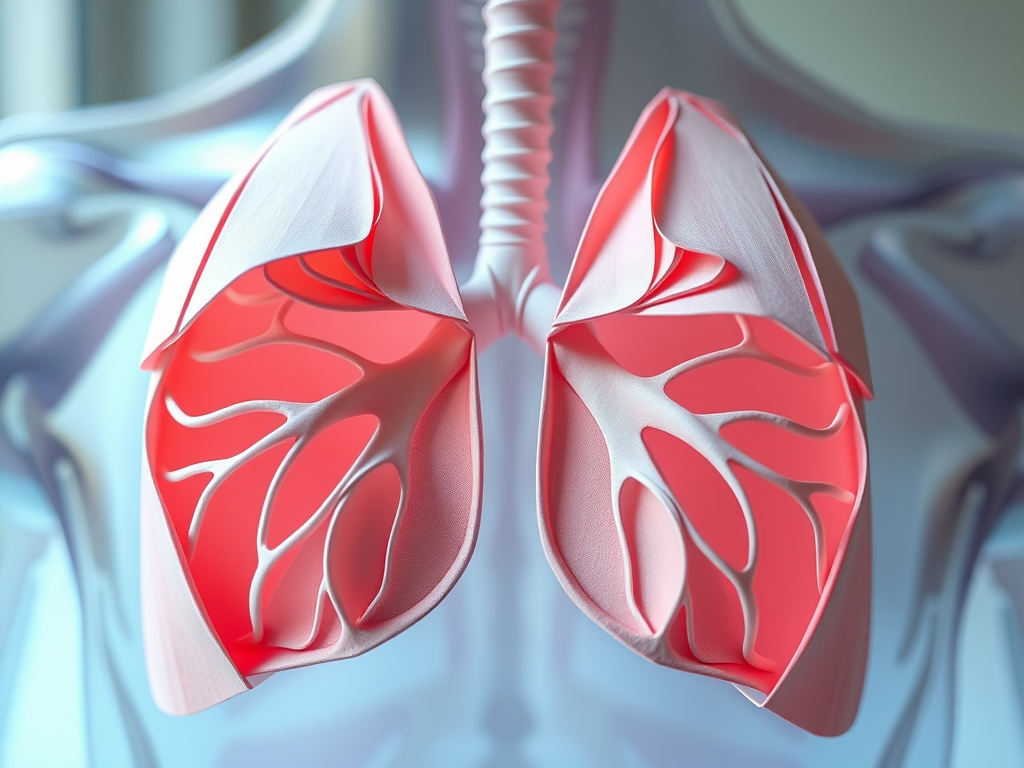

“To breathe is to stretch without breaking — to surrender to the rhythm of expansion and return.”
🌫️ The Breath Beneath the Breath
Every breath you take is a quiet negotiation between strength and surrender. The lungs stretch like a thousand tiny silk balloons, only to recoil again, ready for the next inhale.
This constant expansion and contraction — invisible, rhythmic, tireless — defines one of the most elegant principles in respiratory physiology: the compliance and elasticity of the lungs.
While we often think of the lungs as passive balloons, they are far from it. They are living, reactive tissues — elastic instruments finely tuned by molecular forces, structural architecture, and surface chemistry. To understand their compliance is to understand how every breath finds balance between pressure and volume.
🌬️ What Is Lung Compliance?
Compliance is the measure of how easily the lungs expand when subjected to pressure. It quantifies the distensibility — the ease with which air enters the alveoli.
Mathematically:
Compliance (C) = ΔV / ΔP
Where:
- ΔV = Change in lung volume
- ΔP = Change in transpulmonary pressure
A highly compliant lung inflates easily with minimal effort, while a low-compliance lung resists inflation — like trying to blow air into a stiff balloon.
Normal combined lung–chest wall compliance is about 100 mL/cm H₂O in healthy adults. The lung alone contributes about 200 mL/cm H₂O, and the chest wall about the same, but their opposing elasticities halve the total when combined.
(💡 Metaphor: “Compliance is the kindness of the lung — its willingness to yield to air.”)
⚖️ Elasticity — The Recoil That Defines Return
If compliance is the art of stretching, elasticity is the discipline of returning. It is the tendency of lung tissue to recoil back to its resting volume after being distended.
The lung’s elastic properties are determined by:
- Elastin fibers – coiled, stretchable, and responsible for recoil.
- Collagen fibers – tough, limiting overexpansion.
- Surface tension forces at the alveolar interface.
A lung that is too elastic (like in pulmonary fibrosis) becomes stiff — it resists inflation.
A lung that is too compliant (like in emphysema) stretches too easily — but cannot recoil effectively, leading to air trapping.
“Elasticity without compliance is rigidity; compliance without elasticity is collapse.”
🌬️ Static and Dynamic Compliance — The Stillness and the Motion
Not all compliance is the same.
- Static compliance is measured when airflow is paused — it reflects the true elastic properties of the lung and chest wall.
- Dynamic compliance is measured during active airflow — it incorporates both elasticity and airway resistance.
Static compliance = ΔV / (Plateau pressure – PEEP)
Dynamic compliance = ΔV / (Peak pressure – PEEP)
In Clinical Context:
- ARDS: Both static and dynamic compliance ↓ due to alveolar stiffness.
- COPD or Asthma: Static compliance may be normal, but dynamic compliance ↓ because of increased airway resistance.
The Pressure–Volume Curve — A Story of Hysteresis
The pressure–volume (P–V) curve of the lung reveals a fascinating phenomenon known as hysteresis — the difference between the inflation and deflation paths.
During inflation, higher pressure is needed to overcome surface tension and open alveoli. During deflation, less pressure is required to maintain volume because surfactant stabilizes the alveoli.
This lag between inflation and deflation reflects the lung’s memory — its elastic and chemical resistance to sudden change.
Why It Matters
- Clinical implication: The lower inflection point on the P–V curve indicates the pressure at which alveoli begin to open — guiding PEEP settings in ventilation.
- The upper inflection point warns of overdistension, guiding safe inspiratory pressures.
(🌿 “Like the tide and the shore, the lung never returns exactly the way it came.”)
💧 The Role of Surfactant — Nature’s Balancer
If compliance is physics, surfactant is chemistry — the secret that prevents the lung from collapsing under its own tension.
Surfactant, produced by Type II pneumocytes, forms a thin film lining alveoli. It is composed mainly of dipalmitoyl phosphatidylcholine (DPPC) and specific proteins (SP-A, SP-B, SP-C, SP-D).
Its function is best described by Laplace’s Law:
P = 2T / r
where P = pressure, T = surface tension, r = alveolar radius.
Without surfactant, smaller alveoli (smaller r) would generate higher pressure and collapse into larger ones — a phenomenon called atelectasis. Surfactant equalizes pressures, stabilizing alveoli of different sizes.
It also increases compliance, reducing the work of breathing by minimizing surface tension.
⚙️ The Dual Partnership — Chest Wall and Lung Compliance
The lung does not expand alone. The chest wall has its own compliance, and together they create a composite elastic system.
Their relationship is described by:
1 / Ctotal = 1 / Clung + 1 / Cchest wall
The lung tends to collapse inward; the chest wall tends to expand outward. Their equilibrium forms the Functional Residual Capacity (FRC) — the volume where recoil forces balance.
Changes in body posture, obesity, or pleural effusions alter this equilibrium by modifying chest wall compliance.
“Breathing is a duet — the chest expands, the lung yields, and between them, air is born.”
🩺 When Compliance Fails — Lessons from Disease
Decreased Compliance (Stiff Lungs)
- Acute Respiratory Distress Syndrome (ARDS): Hyaline membrane formation and alveolar flooding increase stiffness.
- Pulmonary Fibrosis: Collagen deposition thickens the interstitium.
- Pulmonary Edema: Fluid impairs expansion and gas exchange.
- Neonatal Respiratory Distress Syndrome (NRDS): Surfactant deficiency causes collapse and severe compliance loss.
Increased Compliance (Floppy Lungs)
- Emphysema: Destruction of elastic tissue increases compliance but impairs recoil.
- Aging: Loss of structural elastin and chest wall rigidity paradoxically elevate compliance yet reduce ventilation efficiency.
Clinical Manifestations
- Low compliance: High plateau pressures, low tidal volumes, rapid shallow breathing.
- High compliance: Air trapping, increased residual volume, prolonged expiration.
🌄 Compliance in Anesthesia — A Delicate Balancing Act
Under anesthesia, compliance becomes a critical variable.
- Supine position → reduces FRC due to diaphragm displacement.
- Pneumoperitoneum (laparoscopic surgery) → increases intra-abdominal pressure, reducing chest wall compliance.
- Muscle relaxation → eliminates spontaneous respiratory effort, leaving full responsibility to mechanical ventilation.
Strategies for anesthesiologists:
- Apply PEEP to prevent alveolar collapse.
- Use low tidal volumes (6 mL/kg ideal body weight) to minimize barotrauma.
- Optimize I:E ratios for better gas exchange.
(⚙️ Clinical note: “Ventilation should respect the lung’s personality — push too hard, and it resists; push too little, and it forgets to breathe.”)
🧠 Reading the Ventilator — Compliance at the Bedside
Modern ventilators allow us to see compliance.
- A flattened pressure-volume loop indicates decreased compliance.
- A left-shifted loop suggests stiffness; a right-shifted loop signals hypercompliance.
- Post-recruitment, loops often shift left and widen — reflecting improved compliance.
This visual feedback helps tailor ventilation in ARDS, COPD, and postoperative patients.
📐 Measurement and Normal Values
| Component | Compliance (mL/cm H₂O) | Remarks |
|---|---|---|
| Lung only | ~200 | High due to alveolar stretchability |
| Chest wall only | ~200 | Decreases with obesity or rigidity |
| Combined system | ~100 | Reflects total respiratory system compliance |
Measurement is typically done under controlled ventilation using the static compliance formula:
Cstat = Tidal Volume / (Plateau Pressure – PEEP)
🌍 Real-World Examples — The Physics of Disease
ARDS
Low compliance due to stiff, flooded alveoli. Requires low tidal volume and high PEEP strategy.
Emphysema
High compliance but poor recoil — leading to hyperinflation and air trapping.
Fibrosis
Markedly low compliance — rapid, shallow breathing to minimize work.
NRDS
Deficient surfactant causes alveolar collapse — exogenous surfactant therapy restores compliance.
💡 The Physics Behind Every Breath
Every breath is a perfect compromise between energy and restraint.
- Too little elasticity — and air cannot escape.
- Too little compliance — and air cannot enter.
Between the two lies the sweet equilibrium that defines effortless breathing.
(🌿 Poetic reflection: “Breathing is not a force, but a surrender — a collaboration between expansion and return.”)
🌸 Key Takeaways
✅ Compliance = change in volume per unit pressure; reflects stretchability.
✅ Elasticity = recoil; determines how readily the lung returns to rest.
✅ Surfactant reduces surface tension, increases compliance, and prevents collapse.
✅ Static vs Dynamic compliance distinguish elastic from resistive components.
✅ Anesthesia, posture, and disease all alter compliance — clinically vital for ventilator management.
✅ Laplace’s Law explains alveolar stability; P–V curves guide ventilator pressures.
(💫 “The lung’s beauty lies not in how much it expands, but how gracefully it returns.”)
📚 References
- West JB. Respiratory Physiology: The Essentials, 11th Edition.
- Guyton & Hall. Textbook of Medical Physiology, 14th Edition.
- Nunn’s Applied Respiratory Physiology, 9th Edition.
- Miller’s Anesthesia, 9th Edition.
- Tobin MJ. Principles and Practice of Mechanical Ventilation, 3rd Edition.
- ARDSNet Trial Protocols, NEJM (2000).
✨ “Breathing, at its core, is a lesson in balance — a silent dialogue between force and freedom.” ✨
Leave a Reply