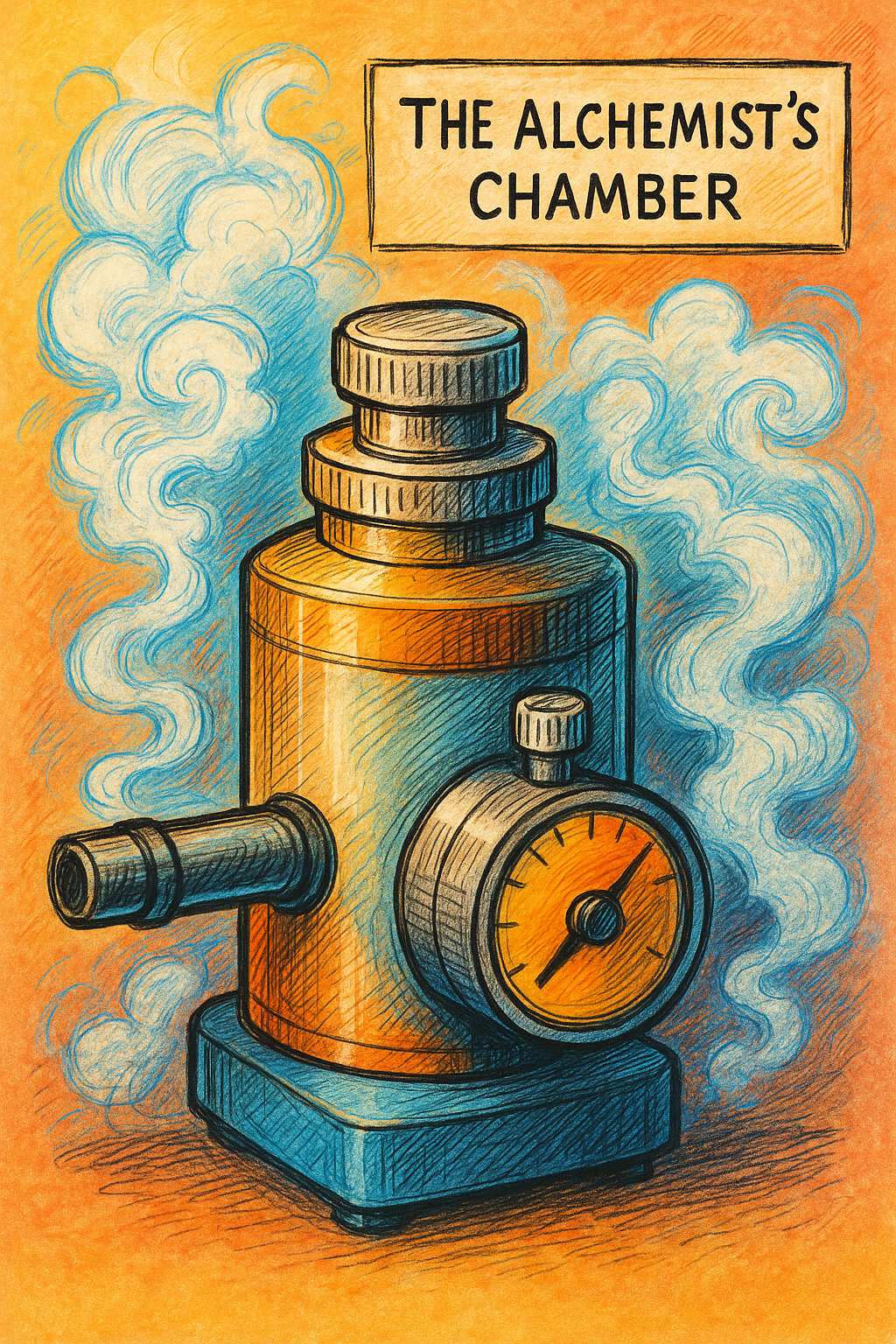
(Variable Bypass • Temperature Compensation • The Art of Delivering Precision)
🎬 Opening Scene — When Science Smells Like Alchemy
Imagine a lab straight out of a fantasy novel: copper tubes, swirling vapors, and a calm alchemist turning liquids into invisible potions of power. That’s exactly what happens every time you turn the dial on a vaporizer!
💡 Each drop of anesthetic agent — halothane, sevoflurane, desflurane — becomes an enchanted mist that coaxes consciousness into sleep.
The vaporizer is your modern alchemist’s chamber, where physics, chemistry, and precision engineering blend into clinical art.
🧠 1️⃣ What Exactly Is a Vaporizer?
“A vaporizer converts volatile liquid anesthetic into vapor, mixes it with carrier gas, and delivers a known, steady concentration to the patient.”
🔍 Formula in four words:
💧 Conversion → 🌬️ Mixing → ⚖️ Regulation → 🌡️ Compensation
⚙️ Concept Box: The 4 Jobs of a Vaporizer
| 🧩 Function | ⚗️ Description | 💡 Keyword |
|---|---|---|
| Conversion | Liquid → vapor | Vapor pressure |
| Mixing | Vapor + gas | Flow dynamics |
| Delivery | Fixed concentration | Variable bypass |
| Compensation | Stability vs temperature | Bimetallic control |
🎼 2️⃣ The Split-Stream Symphony (Variable Bypass Explained)
“Like a maestro dividing the orchestra, the vaporizer splits gas flow — one stream bypasses untouched, the other dances over liquid anesthetic before they merge into harmony.”
🎵 Mechanism Recap:
- Total fresh gas flow enters.
- It divides into:
- Bypass stream → takes the clean route.
- Chamber stream → absorbs vapor essence.
- Both streams reunite with the perfect ratio → precise anesthetic concentration.
📈 Why it matters:
The variable bypass keeps concentration constant even when flow changes (within limits). It’s why your 2 % sevoflurane stays 2 %, not 3 % or 0.5 %.
🌡️ 3️⃣ The Physics Beneath the Magic
⚗️ Vapor Pressure – The Invisible Muscle
Each agent has a specific vapor pressure (e.g., Sevo ≈ 160 mmHg, Iso ≈ 240 mmHg).
As temperature rises, molecules get restless — more escape the liquid, boosting vapor output.
🧊 Cool Trick: Evaporation steals heat (latent heat of vaporization) → cooling the liquid → less vapor.
So… the vaporizer fights back!
🌡️ Temperature Compensation — The Self-Healing Wizard
When cooling threatens consistency:
- 🔩 Bimetallic strips or aneroid bellows bend to redirect flow — more gas passes through the vaporizing chamber to keep output stable.
- 🧱 Copper heat-sinks act like mini thermal batteries.
🧠 Analogy: It’s like your home thermostat adjusting the heater to maintain comfort, but here the comfort zone is your patient’s MAC.
💨 Flow-Over vs Bubble-Through (The Old vs The Bold)
| 💨 Method | ⚙️ How it works | 💬 Comment |
|---|---|---|
| Flow-Over | Gas passes over liquid surface | Modern, stable, predictable |
| Bubble-Through | Gas bubbles through liquid | Old school — like aerating aquarium water 😅 |
💡 4️⃣ Meet the Cool Cousin – The Desflurane Exception
Desflurane is the hyperactive cousin: vapor pressure ≈ 664 mmHg, boils at room temperature!
So, it laughs at traditional vaporizers.
🧯 Solution:
- Heated to 39 °C
- Pressurized to ~2 atm
- Vapour injected precisely into carrier gas
➡️ Desflurane Vaporizers (e.g., Tec 6) are dual-circuit, electronically heated, and sound like they’re from the future.
🧩 5️⃣ Classification of Vaporizers
| 🧮 Category | 🧠 Type | 🔧 Example |
|---|---|---|
| Vaporization method | Flow-over / Bubble-through / Injection | Plenum / Draw-over / Tec 6 |
| Flow handling | Variable bypass / Measured flow | Most vs Desflurane |
| Temperature control | Manual / Auto / Electronic | Copper kettle → Tec series |
| Agent specificity | Generic / Agent-specific | Modern = agent-specific only |
🧠 Quick Concept: Agent-specific design prevents disasters like filling sevo in an iso vaporizer.
Because in anesthesia, “close enough” can be catastrophic.
💎 6️⃣ Clinical Pearl Box (Real-World Magic)
⚠️ Before filling: Always turn OFF — prevents overfilling & dosing errors.
🚫 Never tip > 45° — liquid can flood bypass chamber → vapor overdose.
🔑 Check interlocks — only one vaporizer should ever be ON.
🔥 Desflurane needs power — if power fails, so does vapor output.
🧮 Low-flow warning: Accuracy may drift at extremes — use gas analyzer confirmation.
💬 Pearl of Wisdom: “Trust your vaporizer, but verify with your monitor.”
🧬 7️⃣ Advanced Concepts — Because You’re Not Average 😉
🏔️ Altitude & Pressure
Even though concentration stays fixed, the partial pressure of vapor drops at high altitudes → lighter anesthesia.
🧭 Remember: It’s partial pressure, not % volume, that puts patients to sleep.
🔄 Pumping Effect
During positive-pressure ventilation or O₂ flush, pressure oscillations may push gas back into the vaporizer → temporary spikes in output.
🧩 Fix: Check valves + chamber design.
♻️ Agent Economy Formula
💧 mL liquid/hour ≈ 3 × (dial %) × FGF (L/min)
A smart tip for your eco-friendly low-flow cases 🌱
🤖 Digital Era Vaporizers
New units are like iPhones of anesthesia — digital screens, auto-agent detection (RFID), and closed-loop control.
📡 They even sync with ventilators and record agent usage for audits.
🩺 8️⃣ Clinical Case — When the Alchemist Misfires
“Why is my patient moving? I set 2 % sevo!”
🔍 Investigation:
- Wrong agent filled (isoflurane in a sevo vaporizer).
- Lower vapor pressure → under-delivery → patient awareness.
- Result: tachycardia, hypertension, BIS spikes.
🧠 Lesson:
Every vaporizer has its soulmate agent. Never play matchmaker on your own! ❤️
📊 9️⃣ Quick Revision Table
| 💬 Concept | ⚙️ Mechanism | 🚑 Clinical Relevance |
|---|---|---|
| Variable Bypass | Gas split → bypass + chamber | Consistent output |
| Temp Compensation | Bimetallic strip adjusts flow | Stable concentration |
| Flow-Over | Gas over liquid | Efficient vaporization |
| Agent Specificity | Calibrated design | Safety assurance |
| Desflurane Tech | Heated dual circuit | Manages high volatility |
💥 1️⃣0️⃣ If the Alchemist Falters…
What if your vaporizer fails mid-case?
🧾 Red Flags:
- Sudden drop in end-tidal agent
- Patient movement / tachycardia
- Unexpected depth change
🛠️ Rescue Steps:
- Switch vaporizer off.
- Increase FGF with 100 % O₂.
- Convert to IV anesthesia.
- Swap vaporizer if possible.
💬 The calmest anesthesiologist is the one who knows the machine’s every secret.
🧭 1️⃣1️⃣ Final Reflection
“Every breath of anesthesia is a story of transformation — from liquid to vapor, science to serenity.”
The vaporizer is a humble box hiding three centuries of physics and design brilliance. Treat it like your philosopher’s stone — master it, respect it, and it’ll keep your patients peacefully asleep every single time.
✨ Clinical takeaway:
Understanding vaporizers isn’t about memorizing specs — it’s about controlling the unseen art of consciousness itself.
📚 References & DOIs
- Boumphrey S. Understanding vaporizers. BJA Education. 2011; 11(6): 193–200. DOI: 10.1093/bjaceaccp/mkr021
- Kundra P, Agarwal A. Advances in vaporisation: A narrative review. Indian J Anaesth. 2020; 64(3): 30–35. DOI: 10.4103/ija.IJA_891_19
- Dorsch JA, Dorsch SE. Understanding Anesthesia Equipment, 6th Ed. Lippincott Williams & Wilkins; 2012.
- Gutierrez JJP. Anesthesia Vaporizers. In: StatPearls [Internet]. 2023.
- Eger EI II. Anesthetic Uptake and Action. Springer; 1974.
- Wikipedia contributors. Anaesthetic machine — Vapouriser section. Accessed 2025.
Leave a Reply