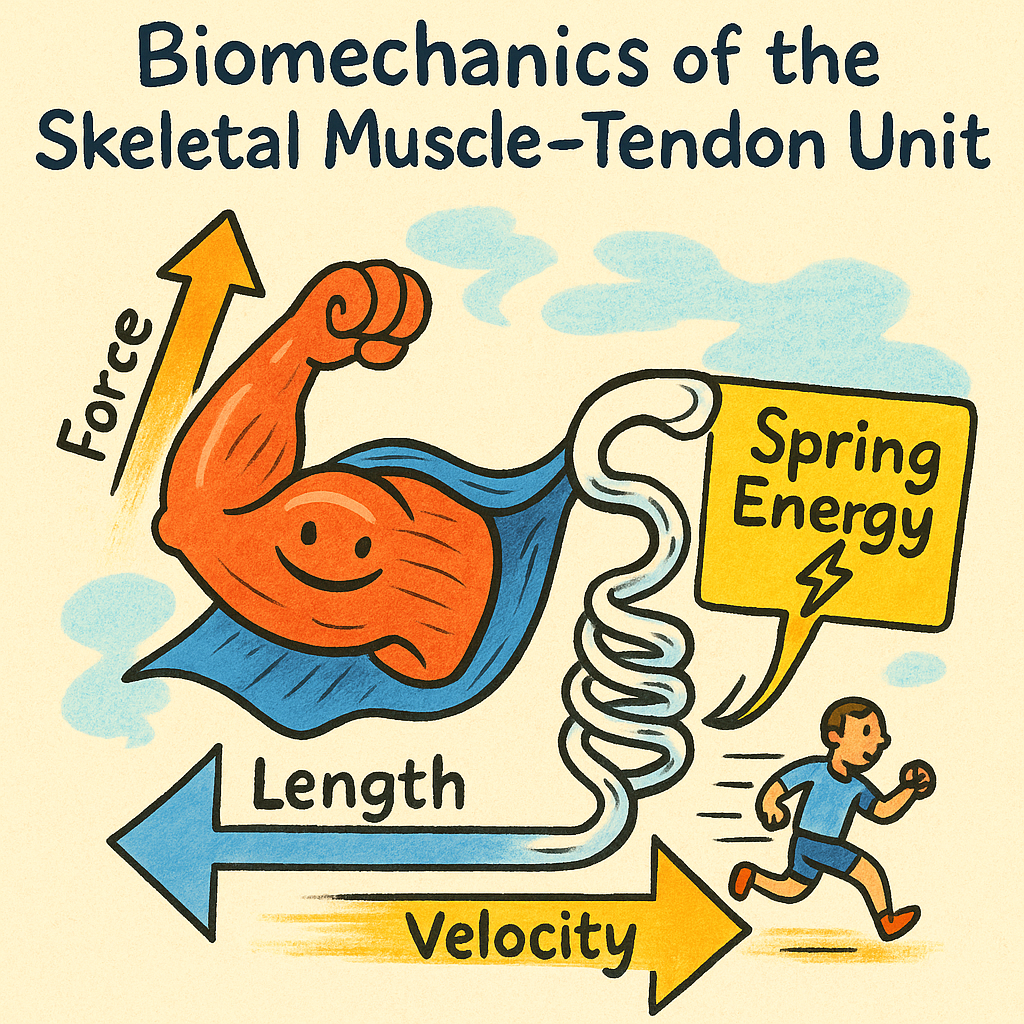
“Every movement is a conversation — muscles speak in force, tendons translate it into grace.”
Our ability to jump, lift, sprint, or even smile is powered by a marvel of natural engineering — the muscle–tendon unit (MTU). This biological duet unites the contractile might of muscle with the elastic intelligence of tendon, creating the perfect balance between power and precision.
Let’s journey through the fascinating science of how force, length, and velocity define performance — from Olympic sprints to surgical recovery. 🏃♂️⚙️
🧠 The Perfect Partnership: Muscle Meets Tendon
Imagine a car engine attached to a spring-loaded transmission.
The muscle is the engine — generating torque and acceleration.
The tendon is the spring — storing and releasing energy to propel motion.
Together, they form a continuum of contractile and elastic elements, the key to both explosive power and smooth control.
🔍 Anatomical Components of the Muscle–Tendon Unit
| Component | Description | Function |
|---|---|---|
| Contractile Element (CE) | Muscle fibers containing actin–myosin filaments | Generates force via cross-bridge cycling |
| Series Elastic Component (SEC) | Tendons and cross-bridge elasticity | Stores and releases mechanical energy |
| Parallel Elastic Component (PEC) | Connective tissue sheaths (epimysium, perimysium) | Provides passive resistance during stretch |
💡 Think of it like an orchestra:
The muscle fibers play the melody, the tendons provide rhythm, and the connective tissues ensure harmony.
🧩 Fun Visual Idea:
Show a sketch of a red muscle (labeled CE), a white tendon spring (labeled SEC), and surrounding sheath (PEC). Arrows indicate “Force,” “Length,” and “Velocity.”
⚙️ Force–Length Relationship: The Sweet Spot of Strength
Just as a bow must be drawn the perfect distance for a powerful shot, a muscle must be stretched to its optimal length to generate maximum force.
This relationship was first detailed in the 1950s by Gordon, Huxley, and Julian, who found that sarcomere length determines how many actin–myosin cross-bridges can form — and thus, how much force can be produced.
📈 The Length–Tension Curve
| Muscle Length | Cross-Bridge Overlap | Force Output |
|---|---|---|
| Too short | Filaments overlap excessively | Low |
| Optimal length (~2.0–2.2 µm) | Maximum overlap | Peak force |
| Too long | Limited cross-bridge interaction | Low |
🔹 At optimal length, all myosin heads find partners on actin — full engagement, maximum tension.
🔹 When overstretched, many bridges can’t connect — tension drops.
🏃♂️ Example: Sprinters crouch before takeoff because pre-stretching their muscles brings them near this optimal length — ready for maximal force generation.
💬 “Power peaks where precision meets proportion.”
🚀 Force–Velocity Relationship: The Speed of Strength
Sir A.V. Hill (1938) revealed another timeless principle:
The faster a muscle shortens, the less force it can produce.
When lifting a light object, muscles contract quickly — velocity is high, force is low.
When pushing against a heavy load, muscles move slowly — velocity drops, force rises.
⚡ Three Types of Contraction
| Type | Movement | Force Output | Velocity |
|---|---|---|---|
| Concentric | Muscle shortens (lifting a dumbbell) | Low | High |
| Eccentric | Muscle lengthens (lowering a dumbbell) | High | Low |
| Isometric | No length change (holding position) | Moderate | Zero |
Eccentric contractions are biomechanical powerhouses — generating up to 1.3–1.5× more force than concentric movements, due to elastic recoil and neural activation.
💪 This is why downhill walking feels harder than climbing — your muscles are braking eccentrically.
💬 “When muscles resist rather than react, strength quietly multiplies.”
🧮 Hill’s Equation (for the nerds 😎):
(F + a)(v + b) = (F_{max} + a)b
Where:
- F = Force
- v = Shortening velocity
- a & b = Constants defining the shape of the curve
This describes the inverse hyperbolic relationship between force and velocity — a foundational equation in biomechanics.
🌀 Elasticity and Energy Storage – The Spring Within the Flesh
Tendons aren’t just attachments — they’re biological springs.
When you land from a jump, tendons stretch, storing potential energy.
When you leap again, that energy releases — making the movement efficient and explosive.
⚙️ Tendon Properties That Define Performance
| Property | Description | Importance |
|---|---|---|
| Stiffness | Resistance to deformation | Affects power transfer |
| Compliance | Ability to stretch | Enhances shock absorption |
| Resilience | Energy recovered vs lost | Determines movement efficiency |
The Achilles tendon can store energy equivalent to 35% of running efficiency — nature’s built-in power booster.
🐆 Cheetahs, with exceptionally compliant tendons, use this property for their legendary acceleration.
💬 “Your tendons are time travelers — borrowing energy from the past and gifting it to your next step.”
💡 Clinical Insight:
Postoperative rehabilitation often targets tendon compliance — too stiff → inefficient motion, too lax → instability.
🏋️♂️ Performance and Efficiency: Finding the Perfect Balance
Performance depends on how well muscle and tendon collaborate.
A stiffer tendon transmits force faster, but a more compliant one stores more energy. The balance defines power output vs endurance.
| Athlete Type | Muscle Fiber Type | Tendon Property | Functional Advantage |
|---|---|---|---|
| Sprinter | Fast-twitch (Type II) | Moderately stiff | Explosive speed |
| Marathoner | Slow-twitch (Type I) | More compliant | Energy-efficient endurance |
| Weightlifter | High cross-sectional area | Stiff tendons | Maximal force |
Training modifies this dynamic:
- Plyometrics → Increases tendon stiffness for power.
- Yoga / Stretching → Enhances compliance for flexibility.
- Eccentric exercises → Strengthen tendon–muscle integration.
💬 “Train your springs wisely — too tight and they snap, too loose and they sag.”
🩺 Injury, Adaptation & Rehabilitation
🚨 Common Failures
- Tendinopathy: Degeneration from chronic overload (e.g., Achilles, patellar tendon).
- Muscle Strain: Overstretching beyond optimal length.
- Rupture: Sudden force beyond elastic limit.
🔄 Adaptation Mechanisms
- Controlled loading → ↑ Collagen synthesis
- Eccentric rehab → Restores alignment & stiffness
- Nutritional support → Vitamin C & amino acids for collagen repair
💡 Fun fact: Tendons adapt slower than muscles — hence “too much too soon” often leads to re-injury.
🧘 Clinical Pearl:
Combine gradual eccentric load, soft-tissue therapy, and functional retraining for full restoration of MTU integrity.
🤖 Frontiers in Muscle–Tendon Biomechanics
Science is now merging biology with robotics — studying the MTU to design bio-inspired exoskeletons and prosthetics.
- Ultrasound elastography measures tendon stiffness in real time.
- Neuro-mechanical models reveal how the nervous system tunes elasticity during movement.
- Robotic limbs now mimic human tendon recoil to reduce energy consumption.
💬 “Nature designed it first — robotics is still trying to catch up.”
🌈 Real-World Reflections
🏃♂️ In sport: Force–velocity optimization defines champions.
🧑⚕️ In medicine: Rehab protocols rely on restoring MTU balance.
⚙️ In engineering: The MTU inspires bio-mechanical innovation.
From the whisper of a tendon’s stretch to the thunder of a sprinter’s stride — this partnership is evolution’s masterpiece.
✨ Conclusion – The Physics of Grace
“In every contraction lives a calculation — of force refined by length and tempered by velocity.”
The muscle–tendon unit is not just tissue — it’s a biomechanical poem, balancing physics and physiology.
Whether in a surgeon’s steady hand, a dancer’s leap, or an athlete’s sprint, the same principle holds:
Performance is the art of perfect tension.
📚 References / Bibliography
- Nigg, B.M., & Herzog, W. Biomechanics of the Musculoskeletal System. Wiley-Blackwell, 3rd Ed., 2018.
- Gordon, A.M., Huxley, A.F., & Julian, F.J. (1966). The Variation in Isometric Tension with Sarcomere Length. J. Physiology.
- Hill, A.V. (1938). The Heat of Shortening and the Dynamic Constants of Muscle. Proceedings of the Royal Society.
- McArdle, W.D. et al. Exercise Physiology: Energy, Nutrition, and Human Performance. 2022.
- Lieber, R.L. Skeletal Muscle Structure, Function, and Plasticity. Lippincott Williams & Wilkins, 2020.
Leave a Reply