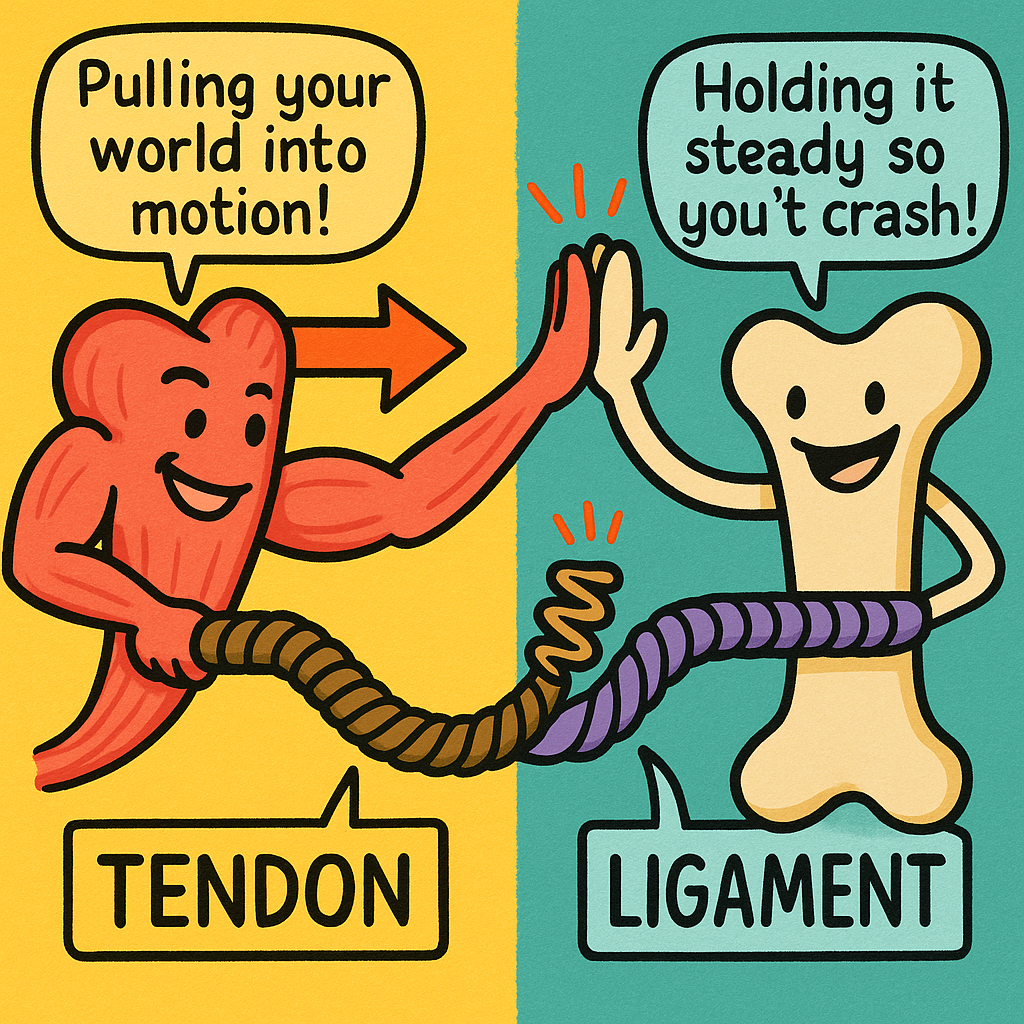
“If muscles are the engines of motion, then tendons and ligaments are the ropes that pull the world into rhythm.”
🌉 Prelude — The Unsung Heroes of Motion
Picture your body as a magnificent suspension bridge 🌉 — bones as towers, muscles as engines, and between them, delicate but powerful ropes hold the entire structure steady. Those ropes are your tendons and ligaments, tirelessly connecting, stabilising, and transmitting every ounce of force.
They don’t boast like muscles or shine like bones, yet without them, movement would collapse into chaos.
In their quiet resilience lies the poetry of control — the science of staying together while moving apart.
🧬 Structure — The Architecture of Strength and Flexibility
At first glance, both tendons and ligaments may look like simple cords, but their microscopic architecture is a marvel of biological engineering.
💪 Tendons — The Force Transmitters
- Connect muscle to bone.
- Built from Type I collagen (≈ 85% of dry weight).
- Arranged in parallel bundles — like tightly twisted steel cables.
- Contain tenocytes (specialized fibroblasts) that maintain collagen and respond to stress.
- Surrounded by epitenon and paratenon for smooth gliding.
🧩 Metaphor:
“Think of tendons as high-tension transmission cables — built for precision, endurance, and controlled elasticity.”
🔗 Ligaments — The Stabilizers
- Connect bone to bone, reinforcing joints.
- Contain slightly more elastin, allowing stretch and recoil.
- Act like safety belts — limiting excessive movement while allowing flexibility.
- Embedded with mechanoreceptors (Ruffini, Pacinian, Golgi endings) — the sensors of joint position and motion.
💬 Analogy:
“If tendons pull the puppet, ligaments ensure it doesn’t fall apart mid-dance.”
🧠 Concept Box:
Tendon = Movement
Ligament = Stability
⚙️ Biomechanics — How the Connectors Work Their Magic
When you sprint, jump, or simply rise from a chair — these silent cables perform a masterclass in force transmission and stability.
⚡ Tendons: The Springs of Motion
Tendons don’t just carry force; they store and release elastic energy — like springs coiled within your limbs.
- During running, the Achilles tendon stores energy when your foot hits the ground and releases it at push-off — saving up to 30% of total energy expenditure.
- The stress-strain curve shows how tendons behave under load:
- Toe region: collagen crimps straighten.
- Linear region: load-bearing zone.
- Failure point: collagen fibrils rupture.
💊 Clinical Pearl:
Controlled loading strengthens tendon structure; overloading tears it apart.
🧠 Concept Box:
“The perfect tendon balances compliance for energy storage with stiffness for control.”
🧩 Ligaments: The Keepers of Stability
Ligaments, unlike tendons, don’t transmit large forces — they guide movement and limit excess motion.
For example:
- Anterior cruciate ligament (ACL) keeps the tibia from sliding forward on the femur.
- Medial collateral ligament (MCL) resists valgus stress.
- Capsular ligaments provide joint proprioception through sensory feedback.
🧠 Did you know?
Ligament fibers realign depending on habitual joint positions — a physiological reminder that use defines form.
💬 Metaphor:
“Ligaments are the compass bearings of movement — you never see them, but you lose your way when they’re gone.”
🔁 Adaptation — When the Cables Learn and Change
These connective tissues are remarkably plastic, adapting to the forces they endure — though slower than muscles.
🏋️♂️ With Training:
- Collagen synthesis increases.
- Cross-links strengthen fibrils.
- Tendons become thicker and stiffer.
🛏️ With Disuse or Immobilisation:
- Collagen disorganisation.
- Decreased stiffness.
- Reduced load tolerance — raising injury risk.
🧠 Concept Box:
“Even the strongest cables sag when left unused.”
💬 Analogy:
“Think of your tendon like a guitar string — tension keeps it tuned; slackness dulls its sound.”
💥 Injury and Repair — When the Rope Snaps or the Knot Loosens
Despite their strength, tendons and ligaments can fail catastrophically — especially when overloaded suddenly or chronically strained.
🩸 Tendon Injuries
- Tendinopathy: chronic degeneration, not inflammation.
- Rupture: often at high-stress junctions (Achilles, rotator cuff).
- Healing is slow due to poor vascularity.
🩹 Ligament Injuries
- Sprains: partial fiber disruption.
- Tears: complete rupture — e.g., ACL tears needing surgical grafting.
- Healing phases: inflammation → proliferation → remodeling (months).
💊 Clinical Pearls:
✅ Early controlled movement promotes aligned collagen formation.
✅ Eccentric loading improves tendon remodeling.
✅ Proprioceptive retraining prevents ligament re-injury.
🧠 Concept Box:
“Healing demands motion — but disciplined, deliberate motion.”
🧪 Biology Behind the Repair — The Microscopic Symphony
At a cellular level, healing involves:
1️⃣ Tenocyte activation → Collagen Type III synthesis.
2️⃣ Gradual replacement with Type I collagen (stronger).
3️⃣ Cross-link maturation over weeks to months.
Growth factors such as TGF-β, VEGF, and PDGF orchestrate the process — summoning fibroblasts, endothelial cells, and immune players.
🧠 Concept Box:
Healing is not merely repair — it’s an attempt to restore the original music of the matrix. 🎶
🩺 Clinical and Practical Implications
For clinicians and therapists, understanding tendon-ligament physiology shapes every rehabilitation decision.
💪 Rehabilitation Principles
- Progressive loading — to stimulate collagen alignment.
- Eccentric exercises — ideal for tendinopathy.
- Proprioceptive drills — essential after ligament injury.
🍎 Nutritional Aids
- Vitamin C, copper, and glycine support collagen synthesis.
- Gelatin + resistance training shown to enhance collagen turnover.
🧬 Future Frontiers
- Stem-cell scaffolds, platelet-rich plasma, and tissue engineering show promise for complex injuries.
- New research explores mechanotherapy — controlled mechanical stimuli to accelerate recovery.
💬 Poetic thought:
“Where sutures meet science, recovery learns to sing again.” 🎻
🧘♂️ Conclusion — The Beauty of Balance
In the symphony of motion, tendons and ligaments are the silent notes that hold the melody together.
They neither contract nor command, but in their stillness lies the secret of strength.
“Muscles may move us, bones may shape us — but tendons and ligaments remind us how to stay whole while we move.”
📘 References / Bibliography
- Benjamin M, Kaiser E, Milz S. Structure-function relationships in tendons: a review. J Anat. 2008;212(3):211–228.
- Wang JHC. Mechanobiology of tendon. J Biomech. 2006;39(9):1563–1582.
- Sharma P, Maffulli N. Biology of tendon injury: healing, modeling and remodeling. J Musculoskelet Neuronal Interact. 2006;6(2):181–190.
- Woo SLY, Hildebrand K, et al. Biomechanics of ligaments and tendons: Lessons from engineering. J Biomech Eng. 2000;122(6):553–558.
- Kjaer M. Role of extracellular matrix in adaptation of tendon and skeletal muscle to mechanical loading. Physiol Rev. 2004;84(2):649–698.
Leave a Reply