“Strength is not born from effort alone — it’s a conversation between what pulls and what bears.”
🌟 Prelude — When Two Systems Talk in Silence
Imagine a muscle and a bone sitting across a coffee table ☕, exchanging notes after a long day:
🦴 Bone says: “You push me, I grow denser.”
💪 Muscle replies: “You resist me, I grow stronger.”
This quiet dialogue — unseen yet constant — is what keeps us upright, resilient, and adaptable.
In every movement, from a surgeon’s steady hand to an athlete’s leap, this biomechanical friendship shapes the human form.
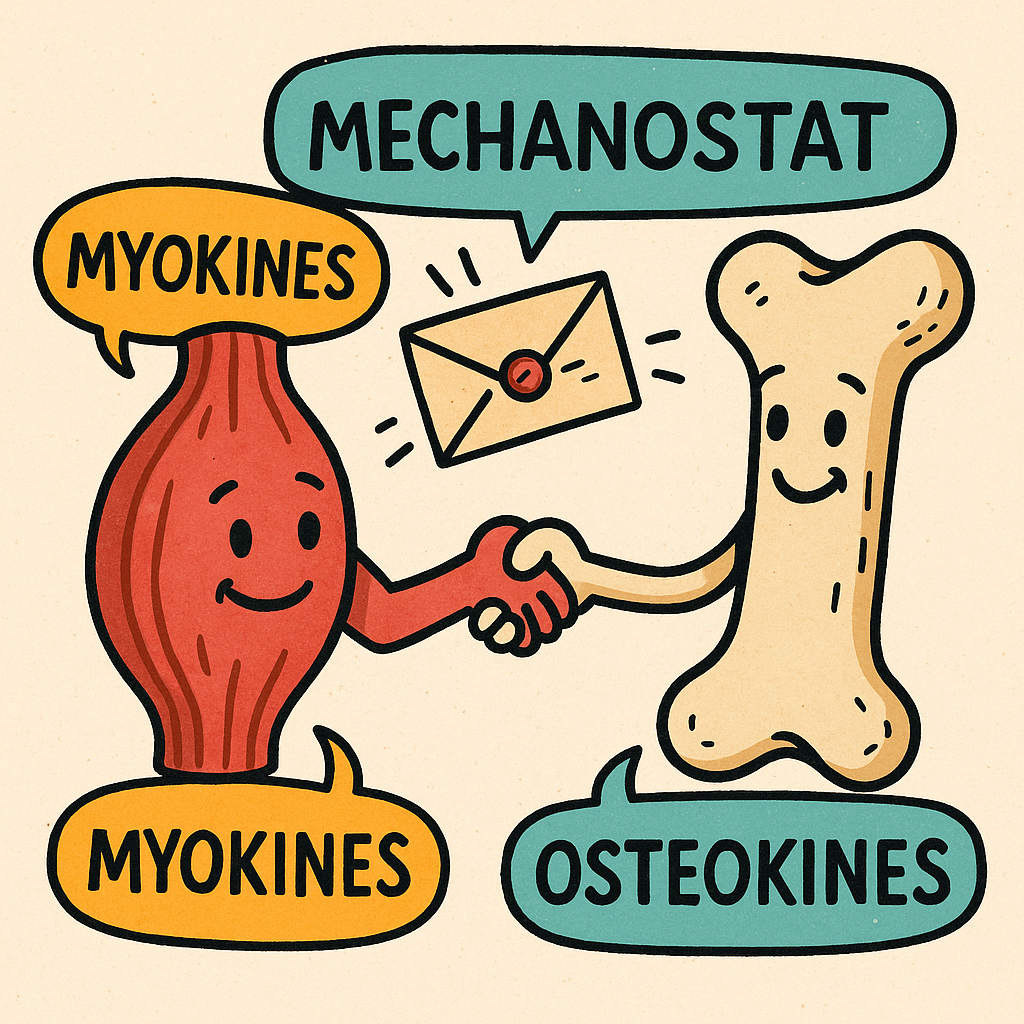
That conversation has a name: the muscle–bone cross-talk, guided by a biological principle called the Mechanostat — nature’s internal engineer of strength.
⚙️ The Mechanostat — Nature’s Strength Meter
The term Mechanostat was first proposed by Harold Frost in 1987 — an elegant theory that bones behave like structures equipped with a strain-sensing thermostat 🔧.
When mechanical load increases, bones grow denser. When it decreases, bones lose mass — much like a thermostat adjusting temperature to maintain balance.
Here’s the principle simplified:
| 🧩 Mechanical Load | 🦴 Bone Response |
|---|---|
| Low (e.g., bed rest) | Bone resorption 🧍♂️➡️ weaker |
| Normal (daily activity) | Maintenance ⚖️ |
| High (training, gravity) | Bone formation 💪 |
💬 Analogy:
“Bone is like a construction crew — idle during calm, but busy when the storm of stress arrives.”
Mechanostat in numbers:
Bone strain of about 1500–3000 microstrain (µε) maintains balance.
Below that → bone loss; above → new bone deposition.
🧠 Concept Box:
The mechanostat links muscle force → mechanical strain → bone remodeling, turning motion into architecture.
🔋 Muscle — The Generator of Load
While gravity provides baseline loading, muscle contraction is the true architect of bone health.
Every pull of a tendon translates into micro-strain, whispering to the bone: “Reinforce here.”
- Greater muscle mass = greater skeletal strength correlation.
- Astronauts in microgravity lose bone density despite normal diet because muscle load disappears.
- Immobilization, casting, or paralysis → rapid bone loss due to missing muscle-derived strain.
💊 Clinical Pearl:
Post-fracture immobilization causes local bone loss within weeks. Early controlled movement prevents irreversible demineralization.
🧠 Concept Box:
“Muscle is the sculptor, bone the clay.”
🧬 Biochemical Cross-Talk — When Signals Replace Shouts
Mechanical pull isn’t the only language they speak.
Muscle and bone communicate through molecular messengers — chemical love letters called myokines and osteokines 💌.
💪 Muscle’s Messages — Myokines
Muscles, once thought to be mere movers, are now recognized as endocrine organs.
They secrete myokines — small proteins that influence bone metabolism.
| 🧪 Myokine | 🦴 Effect on Bone |
|---|---|
| Irisin | Promotes osteoblast differentiation & bone formation 🧱 |
| Myostatin | Inhibits muscle growth and reduces bone density 🚫 |
| IL-6, IL-15 | Modulate osteoclast activity and inflammation 🔥 |
💬 Metaphor:
“Muscle writes postcards in proteins — ‘Grow stronger’, ‘Hold steady’, or ‘Rest awhile.’”
🦴 Bone’s Replies — Osteokines
Bone is no passive recipient either. It releases osteokines — hormones that influence muscle metabolism.
| 🧪 Osteokine | 💪 Effect on Muscle |
|---|---|
| Osteocalcin | Enhances muscle glucose uptake & performance 🚴 |
| Sclerostin | Suppresses bone formation; decreases muscle gain 🚫 |
| FGF-23 | Influences phosphate metabolism, indirectly affecting muscle energy balance ⚡ |
🧠 Concept Box:
The cross-talk isn’t one-way — it’s a biochemical duet, balancing force with form.
🔬 Mechanotransduction — Turning Movement into Messages
How does muscle strain translate into bone growth at the cellular level?
The secret lies in mechanotransduction — the conversion of mechanical forces into biochemical signals.
- Osteocytes (bone’s sensory cells) detect strain.
- They release nitric oxide (NO) and prostaglandins, stimulating osteoblasts to form new bone.
- Integrins and ion channels mediate this response — turning every squat or stretch into microscopic construction orders.
💬 Analogy:
“Think of osteocytes as tiny architects tapping Morse code messages through the bone matrix.”
💊 Clinical Pearl:
Weight-bearing exercises improve both bone density and muscle insulin sensitivity — a perfect example of mechanotransduction at work.
⚠️ When the Dialogue Breaks Down
When this exquisite communication falters, both systems weaken.
1️⃣ Disuse & Immobilization:
Lack of muscle tension → osteocyte dormancy → bone loss.
Seen in prolonged bed rest or paralysis.
2️⃣ Aging (Sarcopenia & Osteoporosis):
Reduced anabolic hormones (testosterone, estrogen, IGF-1) silence cross-talk.
3️⃣ Microgravity:
In astronauts, loss of load causes rapid bone resorption and muscle atrophy — a model of total silence between the two.
4️⃣ Chronic Illness (e.g., Diabetes, Inflammation):
Distorted cytokine profiles disrupt healthy signaling.
💊 Clinical Pearl:
Treating osteoporosis without addressing muscle loss is like fixing a bridge without checking its supports.
🧠 Concept Box:
“Silence between muscle and bone is the prelude to frailty.”
🩺 Clinical & Therapeutic Implications
Understanding this dialogue shapes how we treat and train:
💪 Exercise Prescription
- High-impact, weight-bearing activity stimulates both muscle and bone.
- Eccentric training enhances strain amplitude and mechanostat activation.
🥗 Nutrition & Hormonal Balance
- Adequate protein, vitamin D, and calcium support dual adaptation.
- Endocrine modulation (testosterone, GH therapy) revives the muscle-bone axis in specific pathologies.
💊 Pharmacologic Frontiers
- Myostatin inhibitors, irisin mimetics, and anti-sclerostin antibodies (e.g., romosozumab) target the cross-talk biochemically.
- Future therapies may combine exercise + molecular modulation for optimal results.
🧠 Concept Box:
Rehabilitation that strengthens only muscle or only bone is half a conversation.
🌌 Closing Reflection — The Dialogue of Endurance
From the first kick in the womb to the final step of age, muscle and bone speak the language of adaptation.
Their partnership is ancient, precise, and poetic — a testament to evolution’s craftsmanship.
“Strength isn’t in the muscle nor the bone,
but in their whisper that says — we rise together.” 💫
📘 References / Bibliography
- Frost HM. Bone “Mass” and the “Mechanostat”: A Proposal. Anat Rec. 1987;219(1):1-9.
- Brotto M, Bonewald L. Bone and Muscle: Interactions beyond Mechanical. Bone. 2015;80:109-114.
- Tagliaferri C et al. The Endocrine Role of Muscle and Bone. Cells. 2023;12(16):2088.
- Schoenau E. From Mechanostat Theory to Muscle-Bone Interactions. Pediatr Nephrol. 2005;20(3):304-307.
- Daly RM et al. Exercise, Nutrition, and Hormones in Bone-Muscle Health. Nat Rev Endocrinol. 2024.
Leave a Reply