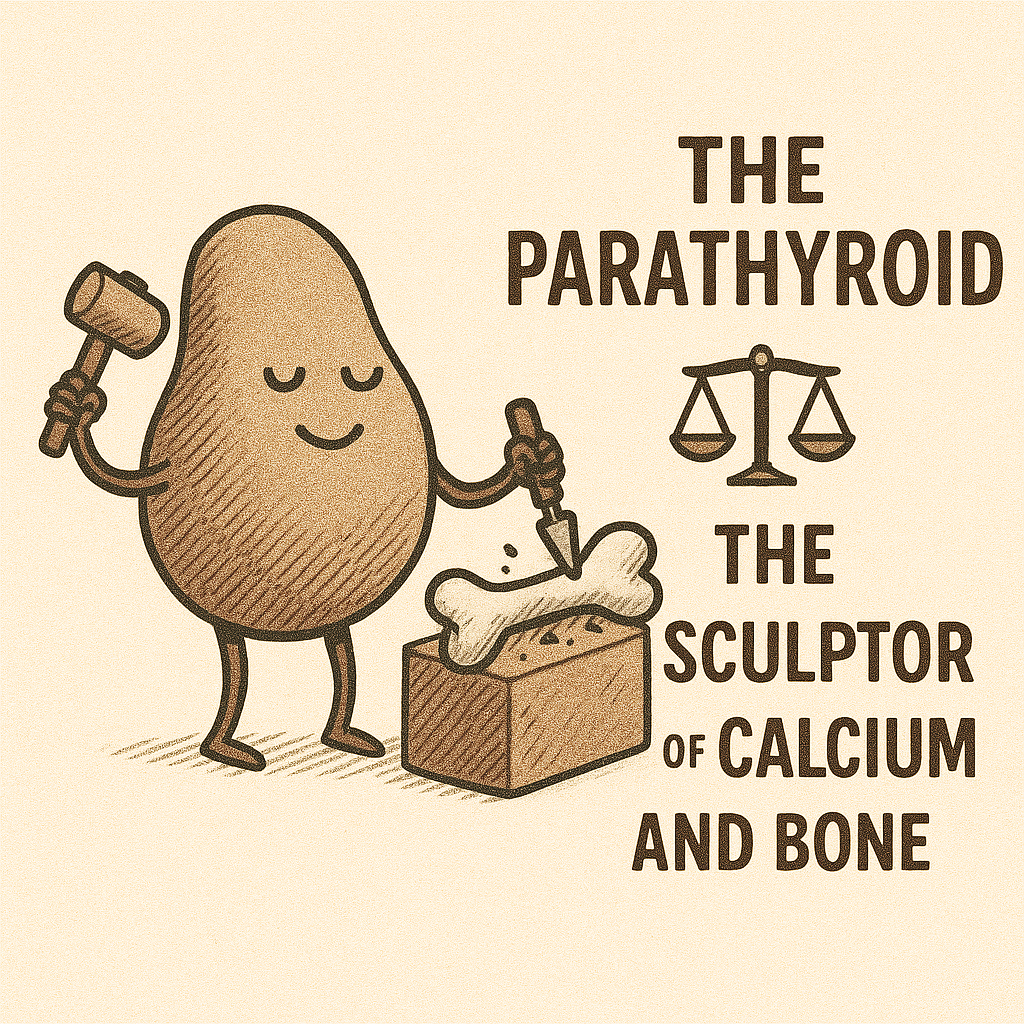
✨ “Not all artists hold chisels — some sculpt with silence and chemistry, shaping strength itself from minerals and light.”
🌟 Introduction: The Silent Sculptor of Strength
Deep within the neck, hidden behind the grand thyroid, reside four tiny glands — humble, silent, yet vital. These are the parathyroids, the unseen sculptors who shape the equilibrium between rigidity and fluidity, between motion and stillness.
Every muscle twitch, every nerve impulse, every heartbeat dances to a rhythm conducted by calcium — and it is the parathyroid that keeps this rhythm pure.
Like a meticulous sculptor carving marble, the parathyroid adjusts calcium and phosphate balance with unerring precision, ensuring that the body’s bones remain both fortress and fountain — rigid for structure, yet generous enough to share their minerals when blood demands.
🩺 Anatomical Prelude: Four Seeds of Balance
Tucked gently behind each thyroid lobe lie four parathyroid glands — each only the size of a lentil, yet pulsing with purpose. Sometimes, they may number more or less, scattered along the neck like hidden pearls.
Each gland is richly supplied by the inferior thyroid artery, ensuring a constant stream of nutrients and oxygen for their tireless work.
Microscopically, they house two types of cells:
- Chief cells — the true artisans that secrete parathyroid hormone (PTH).
- Oxyphil cells — larger, enigmatic cells whose role remains mysterious, perhaps the “apprentices” awaiting purpose.
Despite their proximity, each gland operates independently, a self-contained sensor of calcium concentration — a testament to nature’s redundancy and perfection.
🧬 The Calcium Covenant: PTH as the Master Sculptor
Calcium is life’s mineral currency. It fortifies bones, powers muscle contraction, transmits neural signals, and even drives coagulation. Yet, too much or too little can tip the balance between vitality and disaster.
Here enters Parathyroid Hormone (PTH) — an 84–amino acid peptide, the body’s elegant answer to falling calcium.
When serum calcium levels drop, the Calcium-Sensing Receptor (CaSR) on parathyroid chief cells detects this change — like an artist’s fingers feeling the marble — and instantly releases PTH into circulation.
PTH restores calcium by three beautifully coordinated actions:
- 🦴 On Bone:
- Stimulates osteoblasts to express RANKL, which activates osteoclasts.
- These resorb bone matrix, releasing calcium and phosphate into the blood.
- “A gentle chiseling from the skeleton’s vault.”
- 💧 On Kidney:
- Increases calcium reabsorption in distal tubules.
- Decreases phosphate reabsorption in proximal tubules, preventing unwanted calcium-phosphate crystallization.
- 🌞 On Intestine (Indirect):
- Stimulates renal 1α-hydroxylase, converting vitamin D to its active form (calcitriol).
- Calcitriol enhances intestinal absorption of calcium and phosphate.
🦋 “PTH is the sculptor’s hand — firm yet forgiving, shaping bone and blood into harmony.”
🌤️ The Partner in Light: Vitamin D — The Artist’s Muse
If PTH is the sculptor, Vitamin D is the muse — radiant, quiet, born from sunlight itself.
When ultraviolet rays kiss the skin, 7-dehydrocholesterol transforms into cholecalciferol (vitamin D₃). This precursor travels to the liver, becoming 25-hydroxyvitamin D, and then to the kidneys, where 1α-hydroxylase (stimulated by PTH) refines it into its active form — 1,25-dihydroxyvitamin D₃ (calcitriol).
Calcitriol magnifies PTH’s artistry:
- Increases intestinal absorption of calcium and phosphate.
- Promotes bone mineralization when calcium is sufficient.
- Provides negative feedback to prevent excessive PTH secretion.
🌞 “From light comes life; from sunlight, calcium’s covenant is renewed.”
❄️ The Counterpart: Calcitonin — The Cool Hand of Restraint
Where PTH chisels, calcitonin cools.
Secreted by the parafollicular (C) cells of the thyroid, it acts as the “counter-sculptor.”
When blood calcium rises, calcitonin inhibits osteoclast activity, reducing calcium release from bone and mildly increasing renal excretion of calcium.
While less dominant in adults, calcitonin plays an important role in growth, pregnancy, and lactation, preventing excessive skeletal calcium loss.
⚖️ “If PTH is the fire, calcitonin is the water — together, they temper strength into stability.”
Bone Remodeling: The Dance of Deposition and Resorption
Bone is not a static pillar — it is a living, breathing structure in constant conversation with the bloodstream.
Every moment, osteoblasts (builders) and osteoclasts (resorbers) engage in a subtle duet:
- PTH increases RANKL on osteoblasts → promotes osteoclast differentiation.
- Osteoclasts dissolve bone matrix, releasing calcium and phosphate.
- Vitamin D, meanwhile, ensures that new bone mineralizes properly after resorption.
This ongoing remodeling keeps bones both strong and responsive — as alive as the heartbeat itself.
💫 “Bone exhales calcium into blood and inhales it back — a breath of resilience.”
🔁 The Feedback Ballet: Precision in Control
The calcium feedback loop is among the most elegant regulatory systems in physiology.
- 🩸 Low calcium → PTH release.
- 🧠 PTH raises calcium and lowers phosphate.
- 🌞 Vitamin D rises → enhances absorption.
- 🧩 High calcium → activates CaSR → suppresses PTH.
Each adjustment occurs within seconds to minutes — a living algorithm maintaining serum calcium around 8.5–10.5 milligrams per deciliter.
🌀 “Balance isn’t static — it’s an ongoing conversation between gland and gravity.”
⚠️ Clinical Mirrors: When the Sculptor’s Hand Trembles
Even a perfect artist can falter, and when the parathyroid’s precision fails, the body’s architecture pays the price.
1. Hypoparathyroidism
- Cause: surgical removal (post-thyroidectomy), autoimmune destruction, DiGeorge syndrome.
- Effect: hypocalcemia → neuromuscular irritability, tingling, tetany, and seizures.
- Clinical signs: Chvostek’s sign, Trousseau’s sign.
- Treatment: calcium and vitamin D supplementation.
💧 “When the sculptor’s hand grows still, even muscles turn to marble.”
2. Hyperparathyroidism
- Primary: single adenoma (most common), diffuse hyperplasia.
- Secondary: chronic renal failure (due to phosphate retention and low vitamin D).
- Tertiary: autonomous parathyroid hyperfunction after prolonged secondary stimulation.
- Features: “bones, stones, groans, and psychic overtones” — osteoporosis, kidney stones, abdominal pain, and depression.
- Treatment: surgical excision or calcimimetics (cinacalcet).
🔥 “When the sculptor overworks, the statue begins to crumble.”
3. Pseudohypoparathyroidism
- End-organ resistance to PTH.
- Characterized by hypocalcemia with high PTH.
- Often associated with Albright’s hereditary osteodystrophy (short stature, round face, subcutaneous ossifications).
🧩 “When the message is clear but the marble refuses to yield.”
🚀 Modern Frontiers: Molecular Artistry of Calcium Control
Science now stands beside nature’s sculptor, refining the art of calcium balance:
- 🧬 CaSR Gene Studies: mutations explain familial hypocalciuric hypercalcemia.
- 💊 Teriparatide (PTH analog): intermittent administration stimulates bone formation, revolutionizing osteoporosis therapy.
- 💊 Calcimimetics (e.g., cinacalcet): trick CaSR into “feeling” high calcium, reducing PTH in renal failure.
- 🌞 Vitamin D Analogs: tailored to enhance bone health without hypercalcemia.
- 🤖 AI Models: simulate calcium–bone dynamics for personalized endocrinology.
✨ “The sculptor now works with lasers and logic — guided by data, yet inspired by design.”
🌙 Conclusion: The Silent Art of Balance
The parathyroid glands are perhaps the most poetic of all — silent, small, and selfless.
They never seek attention, yet without them, movement would seize, thought would falter, and bones would forget their strength.
🦴 “In four hidden studios, life’s sculptors work tirelessly — carving fluid into firmness, and firmness into life.”
💫 “Strength is not permanence — it is balance mastered in motion.”
So next time your muscles contract or your heart beats in perfect rhythm, remember: somewhere behind your thyroid, the parathyroids are at work — whispering equilibrium into your very bones.
📚 References
- Guyton & Hall, Textbook of Medical Physiology, 14th Edition
- Ganong WF, Review of Medical Physiology, 26th Edition
- Harrison’s Principles of Internal Medicine, 21st Edition
- StatPearls, Physiology, Parathyroid Hormone, 2024
- Frontiers in Endocrinology, 2023 — “Calcium Homeostasis and Bone Remodeling”
Leave a Reply