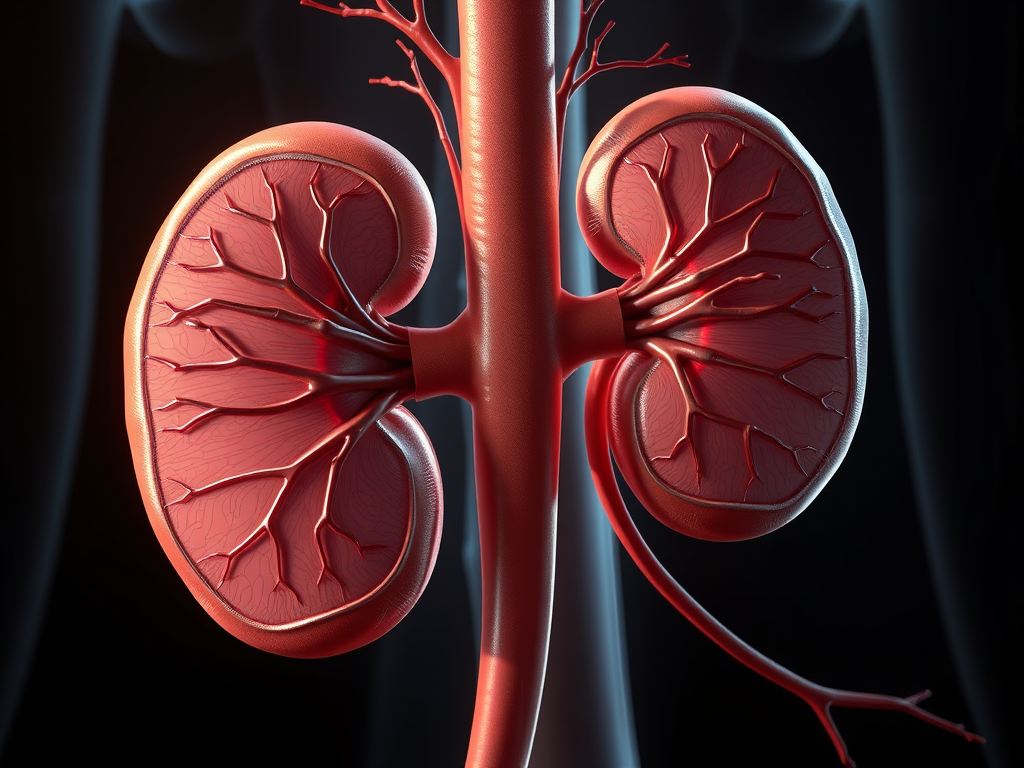
Introduction: The Engine Driving Filtration
The kidneys are highly vascular organs, receiving approximately 20–25% of cardiac output, amounting to 1.2 liters of blood per minute. This robust blood supply is essential for glomerular filtration, electrolyte balance, and acid-base homeostasis.
But how do the kidneys maintain stable perfusion despite fluctuating blood pressures? The answer lies in renal autoregulation, a set of finely tuned mechanisms ensuring that renal blood flow (RBF) and glomerular filtration rate (GFR) remain remarkably constant between arterial pressures of 80–180 mmHg.
This article explores the mechanisms of renal blood flow regulation, autoregulation, and clinical significance in health and disease.
1. Renal Blood Flow (RBF): A High-Pressure System
Renal blood flow is the volume of blood delivered to the kidneys per unit time, approximately 1.2 liters/minute, or 600 mL per kidney.
1️⃣ Distribution of Renal Blood Flow
- Cortex: Receives 90% of RBF → Supplies glomeruli for filtration
- Outer Medulla: Receives 9% of RBF → Active tubular transport
- Inner Medulla: Receives 1% of RBF → Prevents excessive solute washout
2️⃣ Determinants of Renal Blood Flow
RBF is governed by renal perfusion pressure and vascular resistance, following the equation:
- High arterial pressure → Increased RBF
- Increased resistance → Decreased RBF
3️⃣ Resistance Regulation in Renal Vessels
- Afferent Arteriole: Regulates blood entry into the glomerulus
- Efferent Arteriole: Adjusts glomerular pressure and filtration rate
- Peritubular Capillaries/Vasa Recta: Maintain countercurrent exchange in the medulla
2. Autoregulation of Renal Blood Flow: Maintaining a Constant GFR
Despite daily variations in blood pressure, RBF and GFR remain stable due to renal autoregulation.
Mechanisms of Autoregulation
Renal autoregulation occurs via two primary mechanisms:
1️⃣ Myogenic Mechanism: The Kidney’s Pressure Sensor
- Stimulus: Increased arterial pressure stretches afferent arteriolar smooth muscle
- Response: Constriction of the afferent arteriole → Prevents excessive RBF & GFR rise
- Effect: Protects the glomerulus from hypertension-induced damage
✅ Example: During exercise, BP rises, but RBF remains stable due to afferent vasoconstriction.
2️⃣ Tubuloglomerular Feedback (TGF): The Nephron’s Fine-Tuning System
- Sensed by: Macula densa cells in the distal tubule
- Mechanism:
- High NaCl → Afferent arteriole constriction → ↓ GFR
- Low NaCl → Afferent arteriole dilation + Renin release → ↑ GFR
- Effect: Prevents excessive fluid loss while ensuring adequate filtration
✅ Example: In dehydration, low tubular NaCl triggers renin release, promoting vasoconstriction and GFR maintenance.
3. Neurohormonal Regulation of Renal Blood Flow
Beyond autoregulation, systemic factors influence RBF under stress conditions like hemorrhage, dehydration, or sepsis.
1️⃣ Sympathetic Nervous System (SNS)
- Effect: Afferent & efferent arteriole vasoconstriction → ↓ RBF & GFR
- Clinical Role: Protects vital organs during shock (e.g., hypovolemia)
2️⃣ Renin-Angiotensin-Aldosterone System (RAAS)
- Stimulus: ↓ BP → Renin release from JGA
- Effect:
- Angiotensin II → Efferent constriction → GFR maintained
- Aldosterone → Na⁺ & water retention → Volume restoration
✅ Example: RAAS is overactivated in chronic hypertension, leading to nephropathy.
3️⃣ Atrial Natriuretic Peptide (ANP) & Brain Natriuretic Peptide (BNP)
- Stimulus: High BP/stretch of atria
- Effect: Afferent dilation, Efferent constriction → Increased GFR & Na⁺ excretion
✅ Example: ANP counters RAAS activation in heart failure.
4️⃣ Prostaglandins (PGE₂, PGI₂)
- Effect: Afferent arteriole dilation → Preserves RBF during stress
- Clinical Relevance: NSAIDs block prostaglandins, causing acute kidney injury in hypovolemic patients.
4. Clinical Correlation: What Happens When Renal Blood Flow is Altered?
1️⃣ Decreased RBF: Ischemic Kidney Injury
🔻 Causes:
- Severe hypotension (shock)
- Renal artery stenosis
- NSAID-induced afferent constriction
- ACE inhibitors in bilateral renal artery stenosis
🔻 Effects:
- ↓ GFR → Acute Kidney Injury (AKI)
- ↑ Renin → Hypertension
- Tissue hypoxia → Tubular necrosis
✅ Example: Septic shock leads to renal ischemia, causing AKI.
2️⃣ Increased RBF: Hyperfiltration Injury
🔺 Causes:
- Diabetes mellitus (early stage)
- Pregnancy-induced hyperfiltration
- High protein intake
🔺 Effects:
- Glomerular hypertrophy → Nephron damage
- Progression to CKD if sustained
✅ Example: In diabetes, glomerular hyperfiltration accelerates nephron loss, worsening diabetic nephropathy.
Conclusion: A Delicate Balancing Act
Renal blood flow is a critical determinant of kidney function, ensuring optimal filtration and systemic homeostasis. Autoregulation via myogenic response and tubuloglomerular feedback maintains GFR despite BP fluctuations, while hormonal regulation fine-tunes perfusion under stress conditions.
Disruptions in renal blood flow, whether from ischemia or hyperfiltration, contribute to the progression of acute and chronic kidney diseases, emphasizing the importance of early intervention and renal protective strategies.
Key Takeaways
✅ Renal blood flow = 20–25% of cardiac output (~1.2 L/min)
✅ Cortex receives 90% of RBF → Supports filtration
✅ Autoregulation (80–180 mmHg) keeps GFR stable
✅ Myogenic response = Pressure-induced arteriole constriction
✅ Tubuloglomerular feedback = NaCl-sensing mechanism
✅ SNS, RAAS, and prostaglandins modify RBF during stress
✅ Low RBF → Ischemic AKI; High RBF → Hyperfiltration injury
Leave a Reply